OEKO-TEX® STANDARD 100
ATTENTION!
In November 2022, a new design for the OEKO-TEX® label and logo was introduced. Existing labels may continue to be used until the end of 2024. Certificate holders can download the new labels in various formats and color schemes after logging in to the OEKO-TEX® website
click here
OEKO-TEX® STANDARD 100 is the world’s leading safety label for textile products. Products awarded this label are free from harmful substances in concentrations that negatively affect human health, including pesticides, chlorophenols, formaldehyde, allergenic dyes, banned azo dyes, and extractable heavy metals.
Łukasiewicz – ŁIT is the only organization in Poland that conducts certification processes, performs testing, and issues certificates for textile products under the OEKO-TEX® STANDARD 100 label
A BRAND YOU CAN TRUST
OEKO-TEX® STANDARD 100 is a consistent, globally independent testing and certification system for raw materials, semi-finished products, and finished textile goods at all stages of processing, as well as for the auxiliary materials used. Examples of items that can be certified: raw and dyed/finished yarns, woven and knitted fabrics, accessories such as buttons, zippers, sewing threads, or labels, and various types of finished products (clothing, home textiles, bedding, terry products, and many others).
The OEKO-TEX® STANDARD 100 certification confirms compliance with the requirements set forth in Annex XVII of REACH (including the use of azo dyes, nickel, etc.) and the U.S. CPSIA requirements regarding the total lead content in children’s products, with the exception of accessories made of glass.
SAFE
These days, we expect a lot from our clothing and textiles. Our clothes should be fashionable, functional, colorful, yet soft and comfortable to wear. Sportswear should be breathable, absorb moisture, and evaporate it very quickly. Today, these qualities are a given for us, but they wouldn’t be possible without the use of special chemicals in the manufacturing process. The most important thing is that the chemicals used in clothing or textiles do not exceed harmful levels. Only products that have successfully passed rigorous human-ecological tests may use the OEKO-TEX® STANDARD 100 label.
NIEZALEŻNY
INDEPENDENT
All components of textile products must meet the testing criteria of the OEKO-TEX® STANDARD 100. This means literally every single component. In addition to the fabric itself, threads, buttons, zippers, rivets, etc., are also tested. The OEKO-TEX® STANDARD 100 testing criteria are uniform worldwide and updated at least once a year. Only independent institutes from the OEKO-TEX® Association, of which Łukasiewicz – ŁIT is a member, are responsible for testing and authorized to issue OEKO-TEX® STANDARD 100 certificates.
RECOGNIZABLE
Textile products bearing the OEKO-TEX® STANDARD 100 label can be found all over the world. The label is one of the most widely recognized quality marks for textiles tested for harmful substances. It facilitates the sale of textile products, primarily in the markets of the European Union, Ukraine, the United States, Canada, Japan, and others.
Laboratory testing and product classes
OEKO-TEX® testing for harmful substances is based on the intended use of textile products and materials. The more direct contact a product has with the skin, and the more sensitive the skin is, the stricter the human-ecological requirements that must be met. Accordingly, four product classes are distinguished:
Product Class I
Articles for infants and young children up to 3 years of age (clothing, bedding, textile toys, etc.)
Product Class II
Articles in direct contact with the skin (underwear, bedding, table linens, etc.)
Product Class III
Articles that do not come into direct contact with the skin (clothing liners, etc.)
Product Class IV
Decorative items such as curtains, blinds, net curtains, etc.
Certification
A prerequisite for the certification of products in accordance with the OEKO-TEX® STANDARD 100 is that all components of the product—such as fabrics, knitted fabrics, sewing threads, labels, etc.—as well as non-textile accessories, such as buttons, zippers, rivets, etc., meet the required criteria. An additional prerequisite is the existence of an internal quality assurance system, as well as the applicant’s signing of a declaration of conformity.
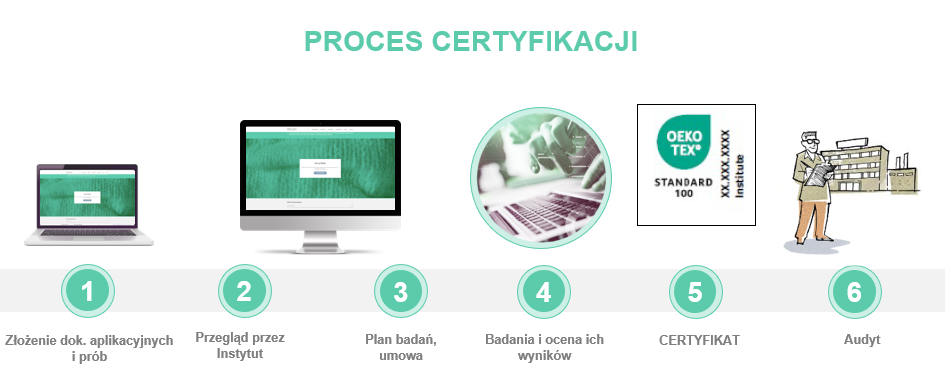
OEKO-TEX STANDARD 100
Standard 1_2026
OEKO-TEX STANDARD 100 PPE
Standard 2_2025
OEKO-TEX STANDARD 100
Special Articles
Standard 2_2025
OEKO-TEX LEATHER STANDARD
Standard 3_2025
OEKO-TEX STANDARD 100
Standard Requirements
OEKO-TEX STANDARD 100 PPE
Standard Requirements
OEKO-TEX STANDARD 100
Special Articles
Standard Requirements
OEKO-TEX LEATHER STANDARD
Standard Requirements
OEKO-TEX STANDARD 100
Application 1_2026
OEKO-TEX STANDARD 100 PPE
Application 1_2026
OEKO-TEX STANDARD 100
Special Articles
Application 1_2026
OEKO-TEX LEATHER STANDARD
Application 1_2026
OEKO-TEX STANDARD 100
Application Attachment
OEKO-TEX STANDARD 100 PPE
Application Attachment
OEKO-TEX STANDARD 100
Special Articles
Application Attachment
OEKO-TEX LEATHER STANDARD
Application Attachment
OEKO-TEX STANDARD 100
Declaration of Conformity 1_2026
OEKO-TEX STANDARD 100 PPE
Declaration of Conformity 1_2026
OEKO-TEX STANDARD 100
Artykuły Specjalne
Deklaracja zgodności 1_2026
OEKO-TEX LEATHER STANDARD
Special Articles
Declaration of Conformity 1_2026
Dział Certyfikacji Wyrobów Tekstylnych i Skórzanych Textil-Cert
Gdańska 118, 90-520 Łódź
tel: +48 42 25 34 432
e-mail: cert@lit.lukasiewicz.gov.pl
MSc Eng. Piotr Kantor
tel. +48 42 25 34 499 | +48 502 424 015
e-mail: piotr.kantor@lit.lukasiewicz.gov.pl
e-mail: oeko-tex@lit.lukasiewicz gov.pl